
Intel in Turmoil. Python on Top. The Rules Just Changed.
Issue #215: It's Python’s turn to shine — Pyx and Obstore upgrade developer infrastructure, AI talent wars heat up, and bold moves from Perplexity and Washington rewrite Silicon Valley’s rules.

Sunil here, Founder of In Plain English, and I can’t remember the last time so many fundamental rules of tech got rewritten in one week.
Talent acquisitions are running wild, the U.S. government is eyeing strategic investment in Intel (read: potential ownership of America's most important chipmaker), and somewhere in between all this chaos, Python developers finally got both the premium platform *and* the cloud storage library they’ve been asking for.
My last project had me knee-deep in Python (with UTCP — an MCP alternative we covered in the last issue!), so that last one actually made my week 😄 — but zoom out, and all three stories point in the same direction: the scarce resource in tech isn’t compute anymore. It’s people.
Companies are buying entire teams, governments are moving to lock down talent-heavy industries, and even in Python, the big shift isn’t the platform itself, it’s that its developers just leveled up — again.
The human capital is reshaping everything. From valuations to product roadmaps.
Let's dig in.
The Headlines📰
The rules that defined the last decade — acquire products not people, keep infrastructure public, let incumbents stay incumbent, keep government out of private enterprise — all got turned upside down in the span of seven days.
🚨 The AI Battle Royale for Human Talent
While we were all worried about GPU costs, the real battle moved to something much scarcer: the humans who know how to use them:
Anthropic just ghost-acquired Humanloop's entire team — not for their product, but for their brains. Why? Prompt engineering at 128K+ token scale is apparently worth more than whatever tech they built.
Microsoft is targeting Meta's AI talent — they've compiled a "most-wanted" list of Meta engineers and researchers, with packages that would make a hedge fund partner jealous.
Of course, this comes after Meta dangled $100M bonuses to lure OpenAI researchers back in June. Sam Altman called it "unprofessional" while basically admitting "yeah, the offers were real and they hurt."
Our Take 👉 Forget GPUs — people are now the rarest resource in AI. Talent is the new bottleneck, and Big AI is willing to pay whatever it takes. The expertise gap between "can run a model" and "can scale it to enterprise" just became the most valuable moat in tech.
Meet Pyx: The Next Evolution in Python Package Management
Speaking of expertise having no substitute…Astral is building the premium layer Python never had.
What happened 👉 Astral just launched Pyx, a Python-native package registry and build backend. Unlike PyPI or Conda, though, Pyx isn’t a public index — it’s a private package registry — offering faster, prebuilt installs, stricter security controls, reproducible builds, and GPU-aware package handling for AI workloads.
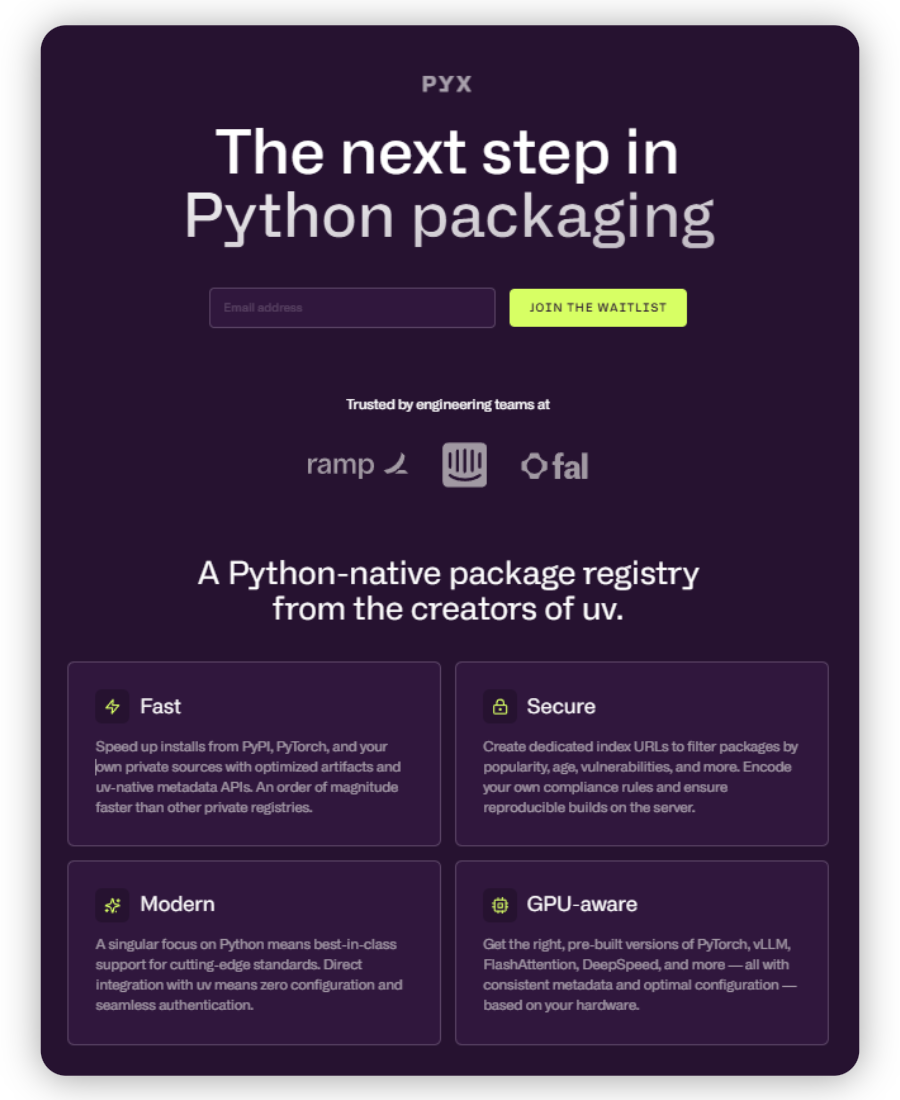
Why this matters 👉 This reveals Astral's monetization strategy: give away the tools (Ruff, uv), but charge for the infra layer. Pyx combines policy-aware features (CVE monitoring, RBAC) with hardware-aware builds (GPU packages, CUDA optimization) — targeting Python teams frustrated with Cloudsmith's licensing and feature bloat.
What’s next 👉 For AI/ML shops, this means less time wrangling PyTorch wheels and more time training models. If it sticks, pyx could become the de facto backend for large-scale Python AI projects.
Python Devs Finally Get Their Cloud Storage Story
Every Python dev has been there: spending half a day wrestling with boto3 version conflicts, watching s3fs crawl through your dataset, or debugging why fsspec is pretending cloud object storage works like your local hard drive (spoiler: it doesn't).
What happened 👉 Python devs, you have a new hero. Development Seed just dropped Obstore, a FOSS Rust-powered Python library that's basically saying "we're done with the janky workarounds."
Dependency-free design — no boto3, no SDK version conflicts, just standard library.
Rust backend for performance — built specifically for large datasets common in geospatial and ML work.
Proper object storage design — actually built for how cloud storage (AWS S3/GCS) works, and not pretending it's a regular file system.
Multi-cloud without vendor lock-in — works across AWS, Google Cloud, Azure without importing their bloated SDKs.
What they did differently 👉 By using Rust for the heavy lifting and exposing minimal Python bindings, Obstore sidesteps the performance bottlenecks that slow down pure-Python libraries when handling lots of files at once.
What's next 👉 Expect other storage libraries to take inspiration from these ideas, and cloud providers to rethink their Python SDKs. The ol’ "pretend it's a file system" approach just had its rude awakening.
Perplexity Just Made the Most Audacious Bid in Tech History
What Happened 👉 Perplexity made a $34.5B bid for Chrome — nearly double their own valuation. They're promising $3B to keep Chromium open source, and they’re backed by Jeff Bezos and Nvidia.
Why This Matters 👉 Good offer, but Chrome could be worth ten times that, according to VCs. The bid is unsolicited, unfunded, and already dismissed by investors as a “crazy” publicity stunt. Still, Perplexity keep framing this as a “commitment to the open web” in a letter to Sundar Pichai, claiming it would run Chrome as an independent steward of the internet’s front door.
Our take 👉 Hey, Bezos and Nvidia didn’t back Perplexity for nothing. Meanwhile, OpenAI, Yahoo and Apollo Global Management have also expressed interest in Chrome. Perplexity may have had the first crack, but this bidding war hasn't even started yet.
The US Government Just Broke Silicon Valley's Most Sacred Rule
After pressuring Intel's head honcho Lip-Bu Tan to step down over China ties, Trump's administration is now considering…taking an ownership stake in the company they just attempted to destabilize?
What actually happened 👉 Bloomberg reports the U.S. government is in talks for a strategic investment in Intel, specifically targeting their troubled Ohio fab expansion. Anyone with two brain cells to rub together gets that this is NOT a loan or subsidy — it's potential government ownership of America's most important chipmaker.
Why this changes everything 👉 Like it or not, Washington just crossed the Rubicon from regulator to owner. The government that spent decades preaching free markets is now willing to become a shareholder in critical tech infrastructure. The message is clear: China's semiconductor dominance spooked America enough to abandon 50 years of hands-off policy.
The domino effect 👉 If the government takes stakes in Intel, what’s stopping similar moves across AI chips, defense tech, and critical infrastructure? The "pure private enterprise" era of Silicon Valley might be ending before our eyes.
Mental health challenges are a normal part of life, and so is asking for help
With BetterHelp, you can match with a therapist easily, message anytime, and get the convenience of therapy that’s 100% online. [Sponsored]
Get Started with 25% off Your First Month
Open Source Spotlight 💫

GoQueue — The flexible Go job queue that grows with you
Saravana Thiyagarajan’s GoQueue (MIT License) wants to solve the "backend lock-in" problem plaguing most queue systems. Start with in-memory for development, scale to Redis for production, or deploy to AWS SQS for cloud — all without changing your background job processing code. Lands in just that sweet spot between Asynq's Redis dependency and Temporal's complexity. 👌
👉 Check out the code here.
Get cheatsheets, dev explainers, and power tutorials across:
Latest Releases 🚀
Another week, another wave of releases across the dev stack.
From frameworks to AI models, we skim the changelogs so your team doesn’t waste hours doing it.
Here’s what actually matters—and what you can skip.
Frontend & Frameworks
Angular 20.2.0-rc.1: Compiler AST span fix + Language Service auto-import support
🔥 Must upgrade if you use template debugging (AST spans) or rely on the Angular Language Service for automatic imports in templates — improves DX greatly for completions + imports.
Next.js v15.4.2-canary.49: Add RouteContext type for app router, memory leak fixes, and Turbopack performance improvements.
🟢 Can upgrade if you use TypeScript with the app router or rely on Turbopack for builds in large apps; otherwise skip; this is a Canary release after all.
🔥 Must upgrade if you use reactive blocks, dynamic components, or rely on flush behavior.
TailwindCSS v4.1.12: Bug fixes across various utilities and integrations
🟡 Skip unless you rely on
@apply,flex-*utilities, template extraction (Elixir/Slang), or environment variable handling.
Backend & Data
Prisma v6.14.0: Preview support for SQL views with @unique attribute + enhanced view capabilities
🔥 Must upgrade if you're using or planning to use views and need relationships,
findUniquequeries, cursor-based pagination, or implicit ordering — do note this is a preview feature.
Redis v8.2.1: Bug fixes for cluster histograms, replica defrag, RDB loading & FLUSHDB
🔥 Must upgrade to avoid potential crashes during replica flushing, RDB loading with XADD/XTRIM, and FLUSHDB operations.
Tooling
ESBuild v0.25.9: Yarn PnP + V8 function optimization
🟢 Can upgrade if you bundle projects with Yarn Plug’n’Play on Windows or want V8 performance hints preserved for immediately-invoked functions.
BiomeJS v3.0.0: Major JS API update
🔥 Must upgrade for improved linting, parsing, and formatting: enhanced CLI reporting, configurable import/key/attribute sorting, new rules for Qwik/Next.js, better Tailwind/HTML parsing, WASM API improvements, and minor performance tweaks. This release also bumps Rust and core dependencies.
IDEs
VS Code v1.50: GPT-5 + TypeScript + Editor Customization
🔥 Must upgrade for GPT-5 and latest TypeScript features! Also, better model management, Copilot chat, terminal workflows, and task tracking.
🟡 Can upgrade if you're using the AuthService, task timeline style, or git workflows — but check for any breaking changes related to removed parameters.
Kilocode v4.81.0: Qwen Code + UI/UX improvements
🔥 Must upgrade for Qwen Code support, improved routing settings, drag-to-pan in the Task Timeline (huge DX win), better virtual quota error handling, new
AutoApproveoption, GPT-5 prompt/commit generation fixes, price transparency updates, and general settings refinements.
AI
Google Gemma 3 270M: Ultra-lightweight multimodal model with 128K context window + multilingual support (140+ languages) + vision capabilities for on-device deployment
🔥 Must try! Smallest model in the Gemma 3 family but trained on 6 trillion tokens, perfect for resource-constrained environments like phones/laptops, handles both text and images with impressive efficiency.
Tencent Hunyuan-GameCraft 1.0: Interactive game video generation model with keyboard/mouse control + hybrid history conditioning + real-time gameplay video synthesis
🔥 Must try! Trained on 1M+ gameplay recordings from 100+ AAA games, transforms keyboard inputs (WASD) into smooth camera movements for controllable game video generation - basically AI that can "play" games visually.
Community Highlights: Our Readers Create Real Solutions That Matter. 🚀
This week's In Plain English community contributions showcase the practical engineering solutions our readers are building — from custom tooling that solves real development pain points to AI-powered systems that actually deliver business value.
5 Practical AI Stacks for Anyone Not Named Google 🥇
⚙ AI / Infrastructure
The anti-FOMO guide to AI infrastructure that acknowledges a simple truth: you're probably not Google, and your AI stack shouldn't pretend to be. This breakdown covers five real-world AI architectures — from the "Just getting started" stack to the "ChatGPT, but for X" virality. Each stack includes specific tool recommendations, cost breakdowns, and honest trade-offs.
How To Create A Raw Loader Plugin for NX Angular Application Executor
🔧 Angular / Tooling
Finally, someone cracked the code on custom NX executors without drowning in boilerplate hell. This deep-dive into building a raw loader plugin for Angular Material Blocks showcases real webpack configuration, real executor patterns, and the architectural decisions that make or break developer experience.
How To Build a Real-Time Job Market Tracker Using AI and Live Web Data
🤖 AI / Data
Tutorial on retrieving 15M+ fresh job listings and using that data to build a real-time job market tracker powered by AI. Complete with Streamlit dashboard, Ollama integration, and automated scheduling.
The Day I Built My Own AI PDF Analyst in Python and Forgot What Manual Review Even Means
🤖 AI / Document Processing
This is what practical AI implementation looks like when you stop chasing ChatGPT for everything and start building solutions to solve your own problems.
A Practical Guide to Building Bidirectional Pagination in AWS DynamoDB
☁️ AWS / Databases
DynamoDB pagination that actually handles both forward and backward navigation without the usual sorting nightmares. This guide cuts through AWS documentation fluff to deliver production-ready pagination patterns that won't break when your users start clicking "Previous" obsessively.
Front-End Inspiration of the Week💥
🔥 Useful Effect – 3D Layered Text
🔥 Useful Trick - Parallax With Scroll-Driven CSS Animations
🔥 Resource - Guide to UI/UX Job Interviews
💎 This issue was sponsored by Bright Data & BetterHelp.
Appreciate you reading.
I share more thoughts about tech, AI, and the chaos of building things on my socials:
Follow me: X | LinkedIn | YouTube | Instagram
(And if you're a scrappy founder, check out Messy Founder—a community I’m building for people like us.)
See you in the next one,
Sunil